Superintendent Battle
The Seven Dials MysterySuperintendent Battle is a Scotland Yard detective who combines an unremarkable public appearance with deliberate patience and sharp investigative judgment. First encountered as a solid, wooden-faced official whom Bundle Brent might mistake for a commissionaire, he later emerges from a mask at a secret Seven Dials meeting as the investigator who has been working inside the organization. His significance rests on this contrast: while others misread his plainness as stupidity, he lets appearances, partial truths, and even minor agents serve a larger inquiry.
Identity and Public Appearance
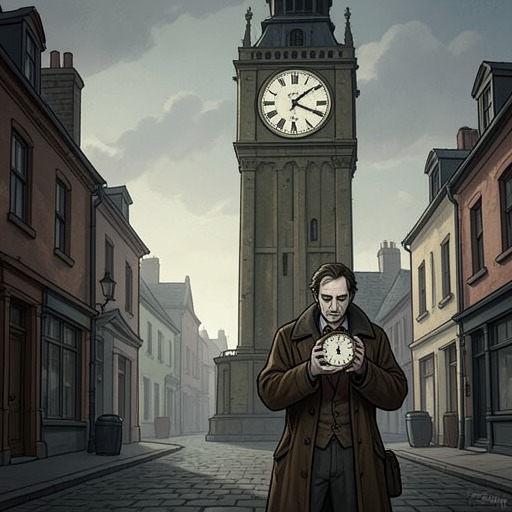
Superintendent Battle works chiefly on cases of a delicate political nature. His earlier visit to Chimneys, four years before the events at hand, gives Bundle Brent a reason to believe he may remember her, and she deliberately relies on that connection when she goes to Scotland Yard to seek his help. The account initially emphasizes an appearance calculated to inspire little awe: he is large, stolid, wooden-faced, and standing at a window watching sparrows when Bundle is brought into his private room. His manner and looks suggest an ordinary official rather than a brilliant detective.
That impression persists even when Bundle encounters him in disguise. At Chimneys, she recognizes the burly figure dressed as a footman as Superintendent Battle. Later, while Bundle creeps along the shadowed terrace at Wyvern Abbey, he is waiting at a corner to bar her way. She is startled, but her assessment has changed: he may have little camouflage in the ordinary sense, yet she knows he is no fool. The difference between his conspicuous physical presence and the intelligence he conceals becomes a recurring measure of how easily appearances mislead.
Trust, Danger, and Investigative Patience
Bundle approaches Superintendent Battle candidly. She admits that she is inclined to intrude, but says she does not want to obstruct his work; she asks only for an opportunity to help as an amateur. He responds that the course she proposes is dangerous, stressing that he means real danger rather than a figurative risk. He nevertheless offers her a hint, accepting her involvement while making the threat plain. Their exchange establishes a cautious working relationship: he does not treat her curiosity as harmless, but neither does he dismiss her because she is an amateur.
When Bundle tells him about the man who was shot and says she thought she had run him over, Superintendent Battle already knows the victim was Ronald Devereux. The lack of newspaper coverage makes her ask why the shooting has been kept out of public view. Later, he lets her see that his caution extends beyond protecting an investigation from interference. In discussing a suspicious countess, he says that the evidence must be secure before action is taken, because a mistake could cause unpleasantness with the Embassies. His restraint is therefore presented as a practical discipline, especially where political sensitivities and uncertainty overlap.
He explains that discipline through an example from the war. When people complained that German spies were being left at large, Scotland Yard paid no attention to the pressure. The minor agents were allowed to remain free because watching them might eventually lead investigators to the person at the top. This policy clarifies why Superintendent Battle can tolerate suspicious activity without immediately intervening: what looks like inaction may preserve a route to a more important target. His method depends on looking beyond the nearest apparent result and allowing a larger pattern to develop.
Reading Evidence Against Appearances
At the shooting at Wyvern Abbey, Superintendent Battle tests the scene against the explanations offered for it. He distinguishes between two bullets: the larger .455 round came from Jimmy Thesiger’s Colt automatic, grazed the window sash, and lodged in a cedar tree; the smaller bullet came from the Mauser .25, passed through Jimmy Thesiger’s arm, and ended in an armchair. The different weapons and their paths matter because they do not support a simple account of one attacker firing at Jimmy Thesiger.
The position of the Mauser also raises a problem. Sir Oswald Coote suggests that the pistol was dropped by a fleeing man, but Superintendent Battle reconstructs what happened from the ground. Sir Oswald’s own footprints lead up from the bottom of the garden to a place where he stopped and stooped; there is also a dent in the grass. Crucially, only one set of footprints crosses the lawn at the relevant point, and it belongs to Sir Oswald. The physical traces therefore contradict the suggestion that another person dropped the gun while fleeing. Superintendent Battle notes, too, that Sir Oswald had moved things from where he found them, though he has been able to reconstruct the scene despite that disturbance.
The final explanation makes the apparent attack a performance staged by Jimmy Thesiger. Superintendent Battle reasons that the arm wound alone could not have made him faint; either he had struck his head or he had not fainted at all. The sequence he describes accounts for the weapons, the wound, and the spectacle of a struggle: Jimmy Thesiger went outside, climbed the ivy to Terence O'Rourke’s room, took the papers, and passed them down to the girl. He then made a commotion inside, speaking first in his own voice and then in a hoarse whisper, before firing his Colt at an imaginary assailant. With his left gloved hand he used the Mauser to shoot through the fleshy part of his right arm, threw the pistol through the window, removed the glove with his teeth, and cast it into the fire. When Superintendent Battle arrived, Jimmy Thesiger was lying on the floor as if unconscious. The apparent victim of an attack had arranged the evidence that made the attack seem real.
The Mask and the Investigation’s Design
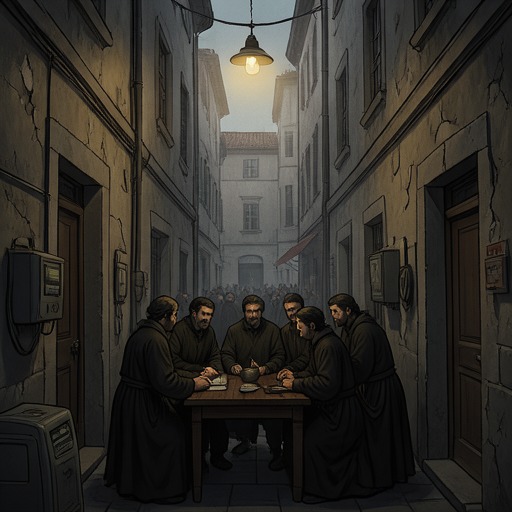
The revelation of Superintendent Battle’s role comes when the mask falls and Bundle sees his expressionless, wooden face. Her surprise is intensified by the setting: she has entered a secret meeting expecting to discover who is behind the organization, only to find that the familiar detective is present among its masked participants. Superintendent Battle explains that Mr. Mosgorovsky has been his lieutenant and has been in the know all along, while most of the others have followed Mr. Mosgorovsky’s orders blindly. The distinction separates those knowingly cooperating with the investigation from members who do not understand who is directing events around them.
That disclosure recasts the detective’s earlier appearances. The man Bundle sought out at Scotland Yard, the disguised footman at Chimneys, and the figure who blocked her way at Wyvern Abbey are not separate surprises but parts of a single, concealed strategy. Superintendent Battle’s ability to wait, to let lesser participants remain active, and to scrutinize the material details of a staged scene belongs to the same method. In a story repeatedly shaped by mistaken identities and misleading surfaces, his wooden face is both a disguise and a fair warning: his unassuming manner should never be taken for lack of understanding.
Narrative Role
Superintendent Battle serves as both investigator and a source of controlled revelation. He gives Bundle limited access while warning her of the danger, and his account of the wartime policy explains why apparent tolerance can be purposeful rather than negligent. His eventual appearance at the secret meeting transforms that explanation into action: he has not merely studied the organization from outside but has had an informed place within its operations.
His reconstruction of Jimmy Thesiger’s shooting supplies the same kind of reversal at the level of physical evidence. Bullets, footprints, a mark in the grass, and a burned glove turn what looked like an assault and collapse into a carefully arranged deception. Superintendent Battle’s defining strength is not flamboyance but the ability to hold back judgment until the separate traces can be made to agree. The story’s contrast between his ordinary exterior and his concealed command mirrors its larger concern with the difference between what a scene appears to prove and what its details actually reveal.